Andrew Clark on FCK squad's physical training this winter
F.C. Copenhagen's head of performance Andrew Clark says the players have had a particularly intense winter break this season, due to the Lions returning to competitive action earlier than usual.
FCK's participation in the UEFA Champions League means there are two games scheduled for January – against SSC Napoli and FC Barcelona – while the Danish Superliga is still in its winter break.
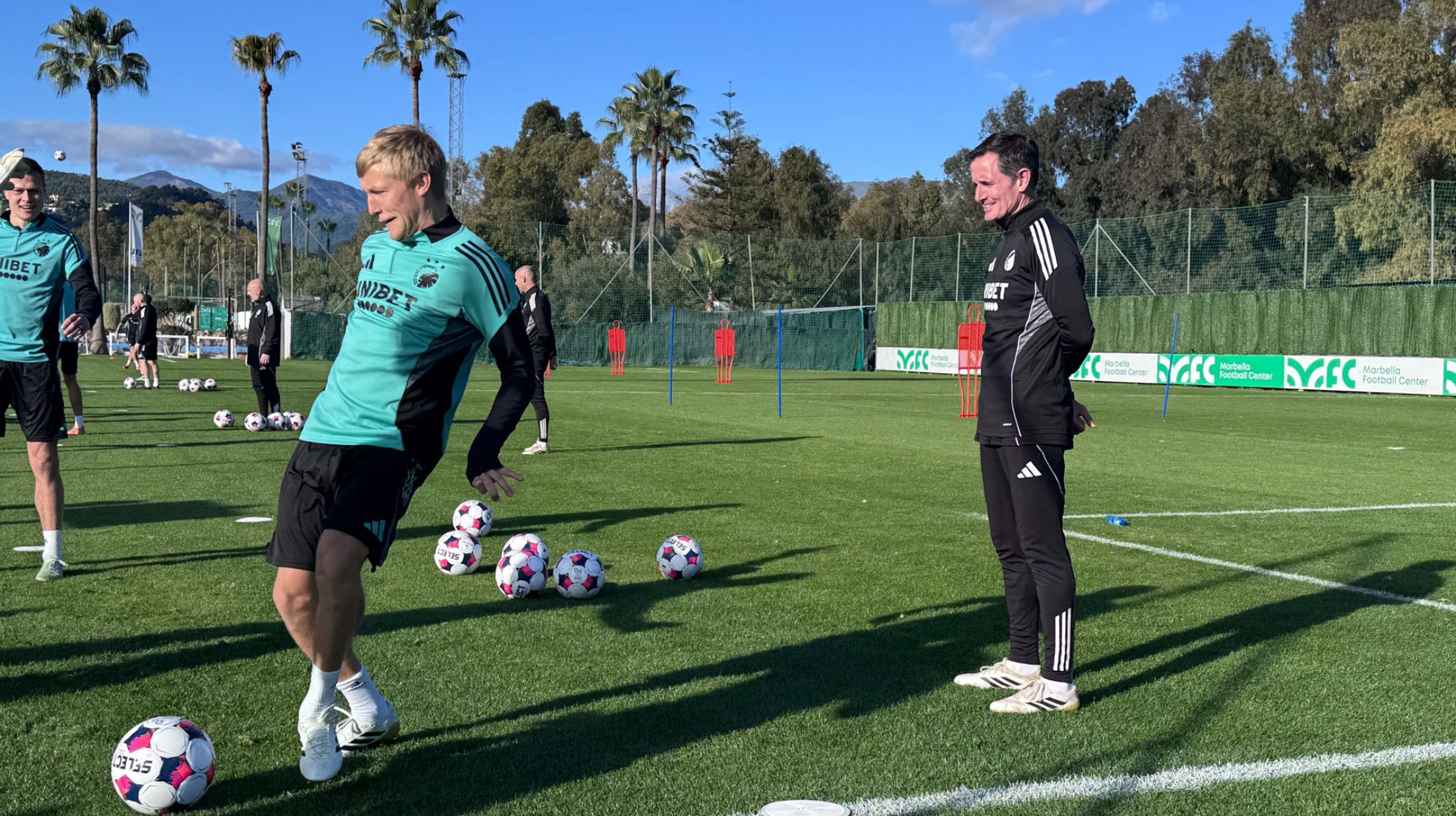
FCK.dk caught up with Andrew during the team's warm-weather training camp in Spain to discuss how the players are preparing for the return to competitive action.
Home training during the Christmas break
"I think a big part of it is that the players' winter break was relatively short - two-and-a-half to three weeks - so we had to get them prepared even before they came back, because it's a very short start when we have to be ready for training matches on the 10th and 14th and for Napoli on 20 January," says Andrew.
“That’s why the players had to prepare more than usual before they arrived, via the individual programmes we gave them, which consisted of two cycles over approximately four days.
“The players travel home to families all over the world, and some have special needs if, for example, they had some injuries in the autumn. That’s why we tailor the programmes individually to give them the best possible conditions to be ready from the start, because we have to get started quickly.
“Already on Wednesday down here (in Marbella), which was actually only our second football training this year, we completed a session that corresponds to about 75 percent of a match, when we look at the numbers after training. So the players have done their homework and are in a good place."
The FCK players went through an intense autumn, where they played 33 games between July and December. It was a tough autumn both physically and mentally, which Andrew admits has to be taken into account when asking the players for more in January.
“Yes, I was very honest with the players and said that for the first seven to ten days I didn’t really want them to think about football training, unless someone had a long-term injury that they needed to work on," he says.
“For most of the players, the most effective thing they could do was to recover fully. We often see that when people take a two-week break without training, some of their strength and power tests show that they are back at a higher level.
“That’s why it was really important to tell the players to rest for seven to ten days and then start slowly again. And the individual programmes allowed them to start carefully.”
"There were a couple of players who had some light sessions on 22 and 23 December, but the vast majority started right after Christmas.”
Priorities in the short start
Addressing the immediate priorities post-New Year, Andrew says: ”We are definitely trying to get their aerobic system going as quickly as possible and get it back up to par. We don’t have time to build it up in the normal blocks that we would do over a four to six week preparation period, so we are compressing the blocks a bit, but the ongoing development will continue all the way up to the start of the Superliga in February.
“Simply put, I focus on training from three perspectives: heart and lungs, legs, and mental preparation. All of our training has elements of all three, but at this point in the season we are focusing mostly on heart and lungs, a little lower intensity and a little more volume. We stay within certain heart rate zones to ensure that the players can do a lot of work without destroying their legs so they can’t train again the next day.
“After that, we will gradually develop it so that the dominance shifts more towards single power actions, repetitions of these and more football-specific things.
“So already on the first day down here we worked on larger areas of the pitch and for longer periods, and then we moved on to running activities, which – very individually based on tests – were aimed at quickly building up the aerobic system.
“Every time you play an important match – a match with high pressure – there is a lot of mental strain. The players have to gear up, and afterwards they have to recover. We're trying to identify how long we can keep the players going before we have to give them a week where we dose them and reduce the load at the right time.
"So I don't think what we're doing now will hurt us in the long run, as long as we balance things correctly, and as long as we have the planning under control and say: this week has this focus, the next week something else, and that we also 'switch them off' again for a period.
"There are also fewer midweek games in the spring than in the autumn, when we played two games a week, and our national team players also played around the world during the international breaks."
Significance for the training matches
Discussing FCK's arranged friendly matches against Brann and Sturm Graz, with Champions League fixtures versus Napoli and Barcelona just around the corner, Andrew adds: "We all know that we have European games in a couple of weeks, so it's important for us to play training games. It's part of our preparation programme.
"But we can't stop our training just because we're playing a game, so we have to be smart so we can 'train through the game'. At the same time, we use the games to give the players extra physical exertion, but they're ready."